

Genocide Inside & Outside of the Prison: A talk with Lena Meari & Basil Farraj on the Palestinian condition and Israel’s carceral regime (Online)
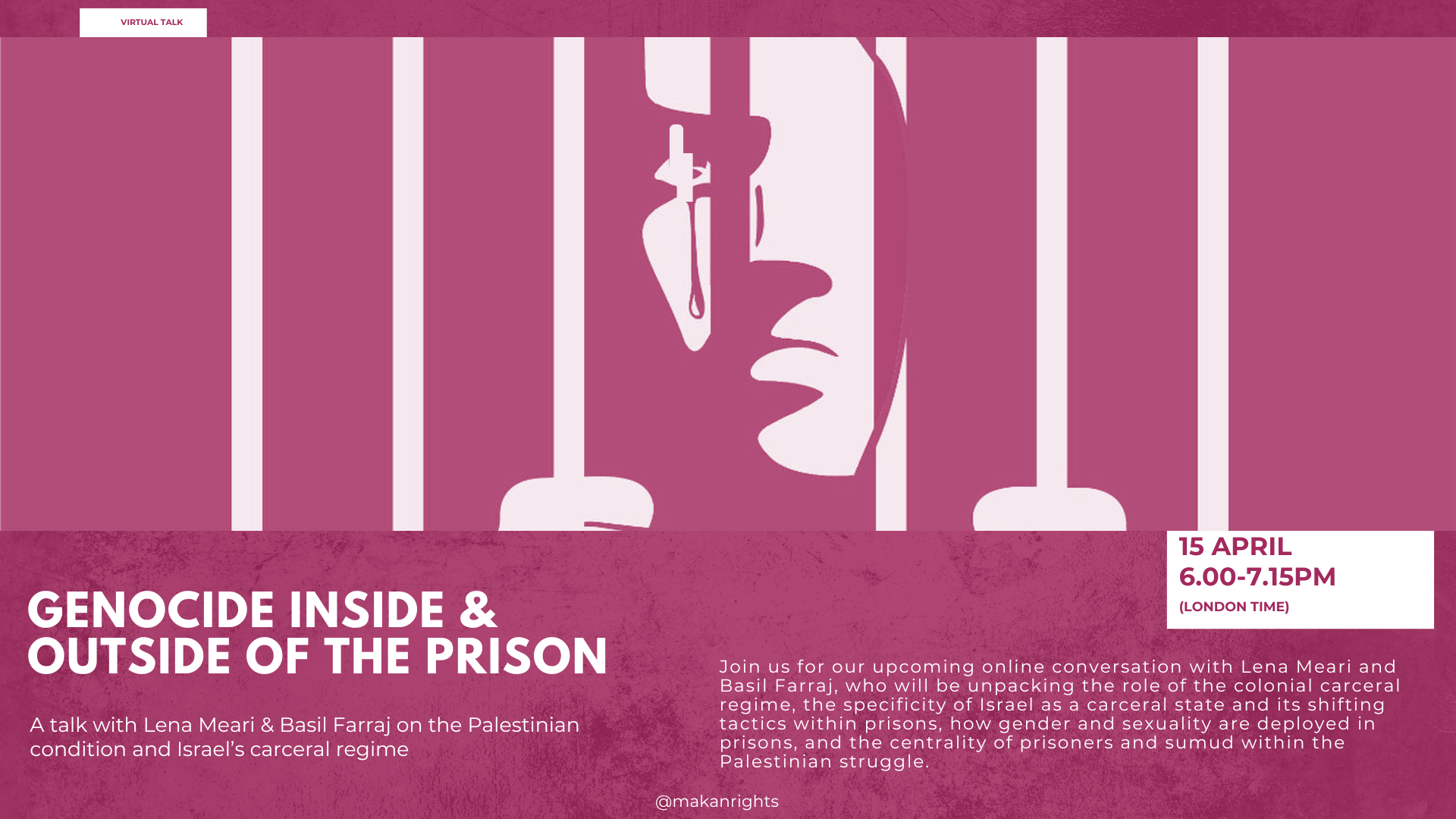
Prisons are a focal site for understanding Palestine and the wider Palestinian condition. Imprisonment as a central tactic helps us see how Israel turns Palestinian land and lives into spaces to criminalise, while using the prison itself as a space of brutal experimentation and extermination.
In the last few years, numerous reports have emerged detailing the horrific treatment of imprisoned Palestinian children, women and men. Imprisonment has been used as a long standing colonial British and Israeli strategy to break Palestinian bonds and capacity to overcome settler colonial violence and live in freedom and dignity, but since the ongoing genocide in Gaza there is an escalation in the employment of violence, particularly sexual violence, turning prisons into a space to accelerate its genocide against the Palestinian people.
Our upcoming online conversation with Lena Meari and Basil Farraj will be unpacking the role of the colonial carceral regime, the specificity of Israel as a carceral state and its shifting tactics within prisons, how gender and sexuality are deployed in prisons, and the centrality of prisoners and sumud within the Palestinian struggle.
About Lena Meari
Lena is an associate professor of cultural anthropology at the Department of Social and Behavioral Sciences and the Institute of Women’s Studies at Birzeit University, Palestine. She received her PhD in Cultural Anthropology with a Designated Emphasis in Feminist Theory and Research from the University of California, Davis. Her special interests lie in the geopolitics of knowledge production; subject formation in colonial contexts; de-colonial feminist theory and methodology; and formations of sumud in the Palestinian context. Her publications include “Sumud: A Palestinian Philosophy of Confrontation in Colonial Prisons”, “Re-signifying `Sexual` Colonial Power Techniques: The Experiences of Palestinian Women Political Prisoners”, and the co-edited books “Rethinking Gender in Revolutions and Resistance: Lessons from the Arab World” and “The Politics of Engaged Gender Research in the Arab Region”.
About Basil Farraj
Basil is the Director of the Ibrahim Abu-Lughod Institute of International Studies, and an Assistant Professor at the Department of Philosophy and Cultural studies, Birzeit University. Basil’s research addresses the intersections of memory, resistance, and art by prisoners and others at the receiving end of violence. He has conducted research in several countries including Chile, Colombia, and Palestine.
About Makan:
Makan is an independent, non-partisan organisation dedicated to interconnected learning. Our approach is grounded in a belief that education is a liberatory act that can lay the ground for structural change. Situating Palestine within the context of other human rights, social justice and global liberation movements, we work towards transformation by adopting educational approaches that capture the history of the Palestinian struggle and the realities on the ground. We aim to support advocates as part of a community that is not only well-informed, interconnected, and empowered, but passionately committed to cultivating a future for Palestinians built on freedom, justice, and dignity.